How False Humility Can Block Your Success (& Hinder Your Gifts)
This article explores the difference between true biblical humility and self-sabotage, empowering you to step confidently into your calling and achieve Kingdom success.
Okay, so I need to talk to y’all about something that’s may sound controversial at first.
I've been watching high-achieving Christians run themselves into the ground… and they're doing it in the name of humility.
They’ve been told their whole life to be humble. To not think too highly of themselves. To put others first. To stay small, stay quiet, stay in their lane.
And they’ve done exactly that.
But here's what I'm seeing:
The version of "humble" you've been taught isn't biblical humility at all.
It's self-hatred dressed up in religious language.
The Humility That's Actually Pride in Disguise
I recently had a client tell me,"I feel like I can't step into leadership because that wouldn't be humble."
This woman has a gift for leading. Talk to her for 2 minutes and you’ll see how God designed her for it.
But she's been convinced that using her gift would be prideful.
Here's what's wild: False humility is actually a form of pride. When you constantly downplay your abilities, avoid leadership roles, or refuse to share your God-given gifts, you're not being humble. You're being self-focused.
Because true humility isn't about thinking less of yourself.
It's about thinking of yourself less.
One of my absolute favorite authors, C.S. Lewis, said that- and he was on point.
But somewhere along the way, Christian culture twisted this into something toxic.
How Christian Culture Got This Wrong
Let me paint you a picture of what "humility" looks like in most Christian circles today:
- You go so low that you completely run yourself into the ground.
- You serve everyone else but never take care of yourself.
- You develop this false humility that breeds self-centered insecurity.
- And you live without confidence or abundance.
My friend- that's not what God intended you to do with your gifts.
I love what Kris Vallotton says about this: "True humility is actually derailed by self-hatred and undermined by low self-esteem."
Wow. Right?
It totally tracks, though- because when you're constantly focused on how inadequate you are, you're still making it all about you… just in a negative way.
All self-demeaning thoughts center your attention on your sense of lack.
They draw your affection away from God and others.
And that’s NOT the point of using your gifts.
The Self-Deprecation Trap
I've watched too many people turn self-deprecation into an art form.
"Oh, I'm not that good at this."
"I'm sure someone else could do it better."
"I don't know why anyone would listen to me."
And they think they're being humble. But they're not. They're dressed up in what looks like humility, but it smacks of pride.
Because whether you're boasting about yourself or bemoaning yourself, you're still putting the focus on self.
Even the desire to be humble can become an all-about-you activity. Which negates the whole thing.
What the Bible Actually Says About Your Worth
Here's what I would invite you to consider:
The Bible says you are fearfully and wonderfully made. (Psalm 139:14.)
Not "kind of okay if you try really hard."
Not "acceptable if you stay small enough."
Fearfully and wonderfully made.
You have unique gifts intended to serve others and glorify God (Romans 12:6-8 also backs this us, if you need a refresher)
So when you fail to recognize your own worth, you're not just diminishing yourself. You're neglecting the divine purpose for which you were created.
Let that sink in for a second.
Henri Nouwen puts it this way: "For a very long time, I considered low self-esteem to be some kind of virtue. I had been warned so often against pride and conceit that I came to consider it a good thing to deprecate myself."
Oh my gosh, yes.
"But now I realize that the real sin is to deny God's first love for me, to ignore my original goodness."
That's the shift I’m calling you to consider.
Gospel Humility Creates Both Contrition and Confidence
Real biblical humility (the kind shaped by the gospel) shows you just how broken you are.
And at the same time, it centers just how great God's salvation is.
It chastens while it emboldens.
It puts you in your place, which is a place of both contrition and confidence.
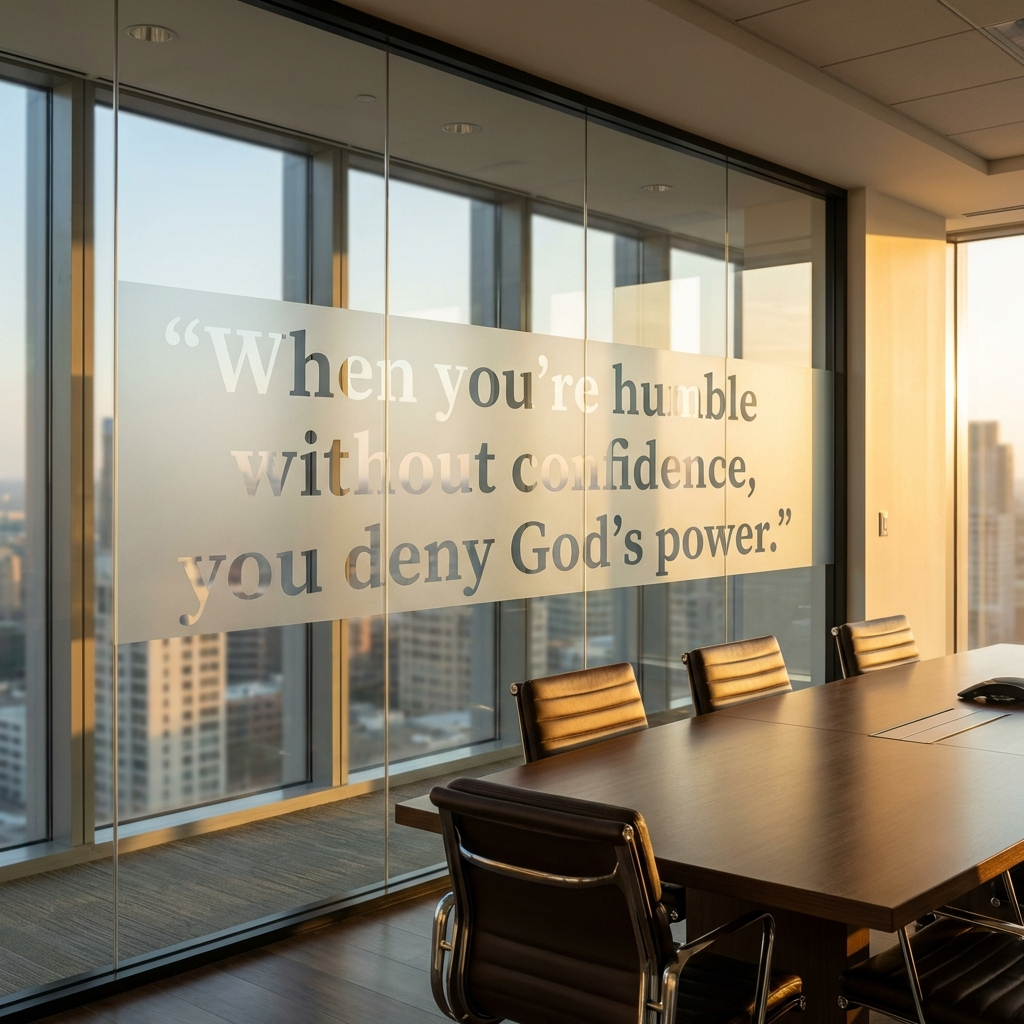
Bill Robinson describes it perfectly in his book Incarnate Leadership: "At once, Christians should be the most humble and confident of all people. When we are confident and not humble, we deny the grace of God. When we are humble and not confident, we deny the power of God."
When you're humble without confidence, you deny God's power.
Read that again.
You're essentially saying, "God, I know you created me with gifts and purpose, but I'm going to hide them because I don't want to seem prideful."
That's not humility. That's disobedience.
Humility Is Not Hiding Your Talents
God equipped you with gifts to use. Being passive about your career, your relationships, or your influence is neither humble nor faithful.
Your drive, when aligned with God's purposes, has the power to shape the world.
That's not arrogance. That's stewardship.
If C.S. Lewis is right that humility means thinking of yourself less, then denying your talents is the opposite of humility. Because you're still focused on yourself—just biased against yourself as an exception to the rest of humanity.
True humility means the death of this self-referential framework.
What Gospel Humility Actually Looks Like
Here's what I'm seeing with people who make this shift:
Gospel humility doesn't make you gloomy, timid, or passive.
It makes you joyful, courageous, and industrious.
It frees you to step into the gifts God gave you without constantly second-guessing whether you're being "too much."
It allows you to lead, teach, create, and build—not because you think you're amazing, but because you know God is.
And you're co-creating with Him.
That's the difference.
The Shift from Self-Focus to Kingdom Focus
Real humility shifts your focus from "Am I good enough?" to "How can I serve?"
From "What will people think of me?" to "What does God want to do through me?"
From "I need to stay small" to "I need to steward what He's given me."
Here is the crucial takeaway-
Fear masquerading as humility is one of the enemy's favorite tactics.
Because if he can convince you that using your gifts is prideful, he can keep you from building God's Kingdom.
That's the point.
Moving Forward: What This Means for You
So here's what I would invite you to do:
Ask the Holy Spirit to show you where false humility has kept you small.
- Where have you confused self-hatred with godliness?
- Where have you hidden your gifts because you were afraid of being "too much"?
- Where have you stayed silent when God was calling you to speak?
Let God show you the difference between biblical humility and the toxic version you've been taught.
Because you were created for more than just worldly success, friend.
You were created for Kingdom significance.
And that requires you to step into who God made you to be- fully, confidently, and humbly.
Does this resonate with you?
If this hit you in a way you weren't expecting, I would invite you to sit with it. Journal about it. Ask God what He wants to shift in your understanding of humility.
Because the world needs you operating in your gifts. Not hiding them.
God's so good.
Always Rooting for You,
Dr. Lee